




The Spain grid plan approved on 20 November commits €17 billion to the transmission network to 2030 and is designed to connect about 47 GW of additional electricity demand. The previous planning cycle made room for about 2 GW. The scale of the change is a measure of how far Spain is betting on electrification, renewable hydrogen and data centres to absorb its solar and wind output.
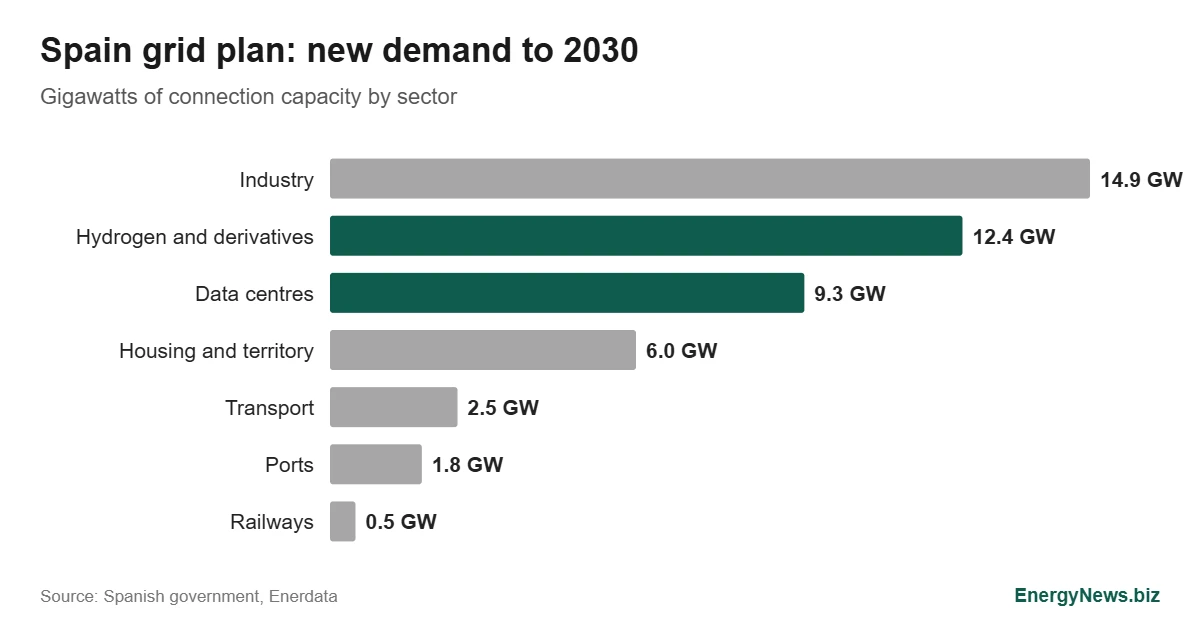
Two sectors stand out in the Spain grid plan. Renewable hydrogen and its derivatives are allocated 12.4 GW, and data centres 9.3 GW. Together they account for 21.7 GW, or 46% of the new demand, according to government figures reported by Enerdata.
What the Spain grid plan builds
The Spain grid plan, a binding development plan for the transmission network, includes 6,707 km of new lines, 8,164 km of reinforced existing lines and 193 new substation sites. About 55% of the new demand is expected to connect through the transmission network and 45% through distribution networks. The plan is also meant to integrate the 154 GW of renewable capacity foreseen in the updated national energy and climate plan.
| Sector | GW | Share |
|---|---|---|
| Industrial electrification and decarbonisation | 14.9 | 31% |
| Renewable hydrogen and derivatives | 12.4 | 26% |
| Data centres | 9.3 | 20% |
| Housing and territorial development | 6.0 | 13% |
| Transport | 2.5 | 5% |
| Ports | 1.8 | 4% |
| Railways | 0.5 | 1% |
| Total | about 47.4 | 100% |
Cost per GW, per km and the payback claim
Three simple ratios help put the €17 billion in context. They are rough, because the budget covers lines, substations and reinforcements together.
- Per GW of new demand: about €359 million, or €359 per kW.
- Per km of new and reinforced line combined: about €1.14 million, including substations.
- Payback on the government’s estimate of €3.6 billion in annual system savings: about 4.7 years.
The savings figure is the government’s, and the method behind it has not been published in detail. It most likely includes lower congestion and redispatch costs and less curtailment of renewable output. Germany shows what happens when the grid lags generation: the cost of curtailment and redispatch has become a political issue, as the record German imbalance prices illustrate.
From gigawatts to terawatt-hours
The Spain grid plan reserves connection capacity, not energy. Whether a connection turns into consumption depends on how many projects get built and how hard they run. The calculation below uses stated load factors to show the order of magnitude.
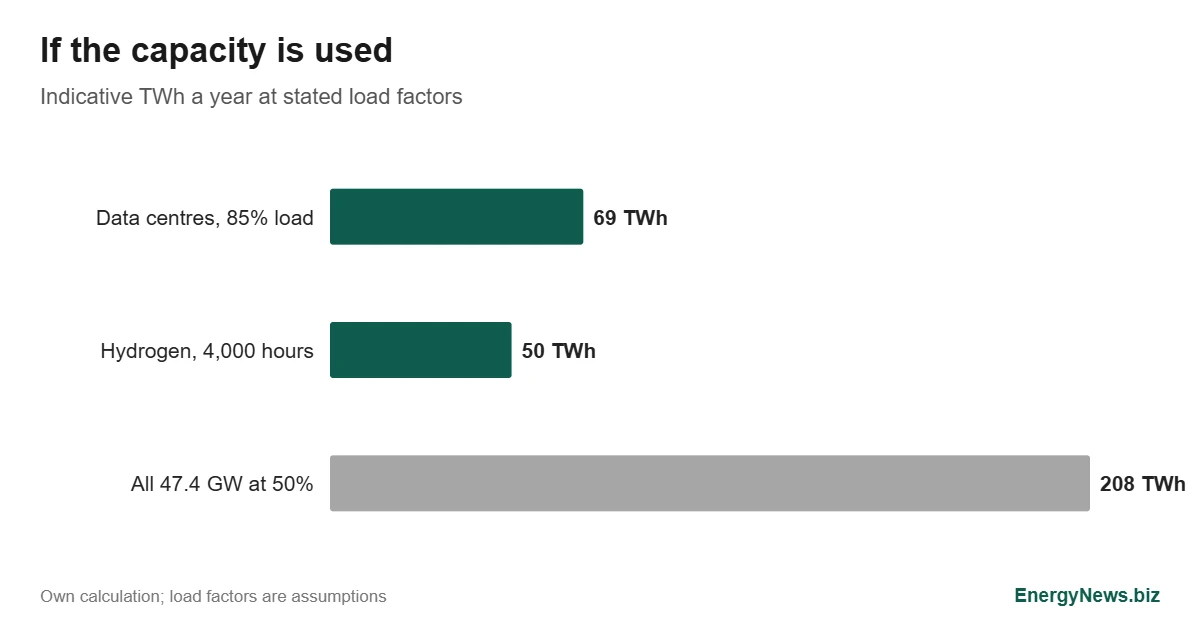
- Data centres run close to flat. At an 85% load factor, 9.3 GW would use about 69 TWh a year.
- Electrolysers following solar and wind output might run about 4,000 full load hours. At that rate 12.4 GW would use about 50 TWh a year.
- If all 47.4 GW ran at an average 50% load factor, the new demand would be about 208 TWh a year.
The last figure would be close to doubling Spain’s current electricity demand, which shows that the plan is sized for optionality rather than a forecast. Many reserved connections will never be used in full; the point is to stop grid access from being the reason a factory or a data centre goes elsewhere.
The hydrogen bet inside the plan
For hydrogen developers, 12.4 GW of reserved capacity in the Spain grid plan is a strong signal. Spain has one of the largest pipelines of electrolysis projects in Europe, and recent final investment decisions such as Repsol’s 150 MW Tarragona project show that some are moving. Yet 12.4 GW is many times the capacity under construction today. If projects keep slipping, as many have across Europe, a large share of that capacity could remain unused by 2030 while other users wait.
The rules for releasing unused capacity will therefore matter as much as the headline. Developers should expect milestones and deposits to be enforced more strictly as demand for connections grows.
Data centres must match 80% renewable power hour by hour
The government approved separate rules for data centres. They must source at least 80% of their electricity from renewables, matched hourly between renewable generation and consumption, with a transitional regime. The government says the rules are designed to avoid about €5 billion of added costs for other consumers.
Hourly matching at 80% is demanding. A flat 100 MW data centre needs renewable supply in every hour, including nights and windless winter weeks. That pushes operators towards contracts that combine solar, wind, storage and possibly flexible demand. At 85% load, the 9.3 GW allocation would need roughly 55 TWh a year of hourly matched renewable power to meet the 80% rule.
What is missing: storage
The published summary of the Spain grid plan does not mention storage. Spain targets 22 GW of storage by 2030 in its national plans, and batteries can both relieve congestion and help data centres meet hourly matching. How the network plan treats stand-alone and co-located storage connections is likely to be one of the first questions from developers.
Why the Spain grid plan matters beyond Spain
Spain has some of the lowest solar costs in Europe and frequent hours of zero or negative wholesale prices in spring. That makes it a natural location for loads that can follow cheap power: electrolysers, data centres with flexible cooling, electrified industrial heat. The constraint has not been energy but connection. Developers have waited years for access points, and many projects announced since 2021 stalled for lack of capacity at the right substation.
By reserving 47 GW for demand, the Spain grid plan turns that constraint into a competitive advantage. A company comparing sites for a 200 MW data centre or a 100 MW electrolyser in southern Europe will now weigh Spanish grid availability against long queues in Germany, the Netherlands and Ireland. The 80% hourly renewable rule for data centres will deter some operators, but it will attract those whose customers ask for verified clean power.
For equipment suppliers, the Spain grid plan also means a large order book for transformers, high voltage cables and substations at a time when lead times for large power transformers already stretch to several years. Red Eléctrica and its suppliers will need to secure manufacturing slots early, or the 2030 horizon will slip.
For neighbouring systems, more Spanish demand reduces the pressure to export surplus solar through the limited interconnection with France. That could ease some of the curtailment that has hit Iberian solar output in recent years.
Investors should also note what the plan does not promise. Reserved capacity is not a connection agreement, and a connection agreement is not a firm date. Each project will still need permits, land and a commercial case, and the Spain grid plan only removes one of the barriers.
What to check next
- The list of specific nodes and substations, and how much capacity each offers to each sector.
- Rules for reallocating capacity reserved by projects that miss milestones.
- The method behind the €3.6 billion savings claim.
- How storage connections are counted against the 47 GW.
The number to watch
For the Spain grid plan, the number to watch is the share of the 12.4 GW hydrogen allocation that holds a signed connection agreement and a final investment decision by the end of 2027. Below 20%, the Spain grid plan will face pressure to hand part of that capacity to data centres and industry instead.
Add EnergyNews.biz as a preferred source on Google


