


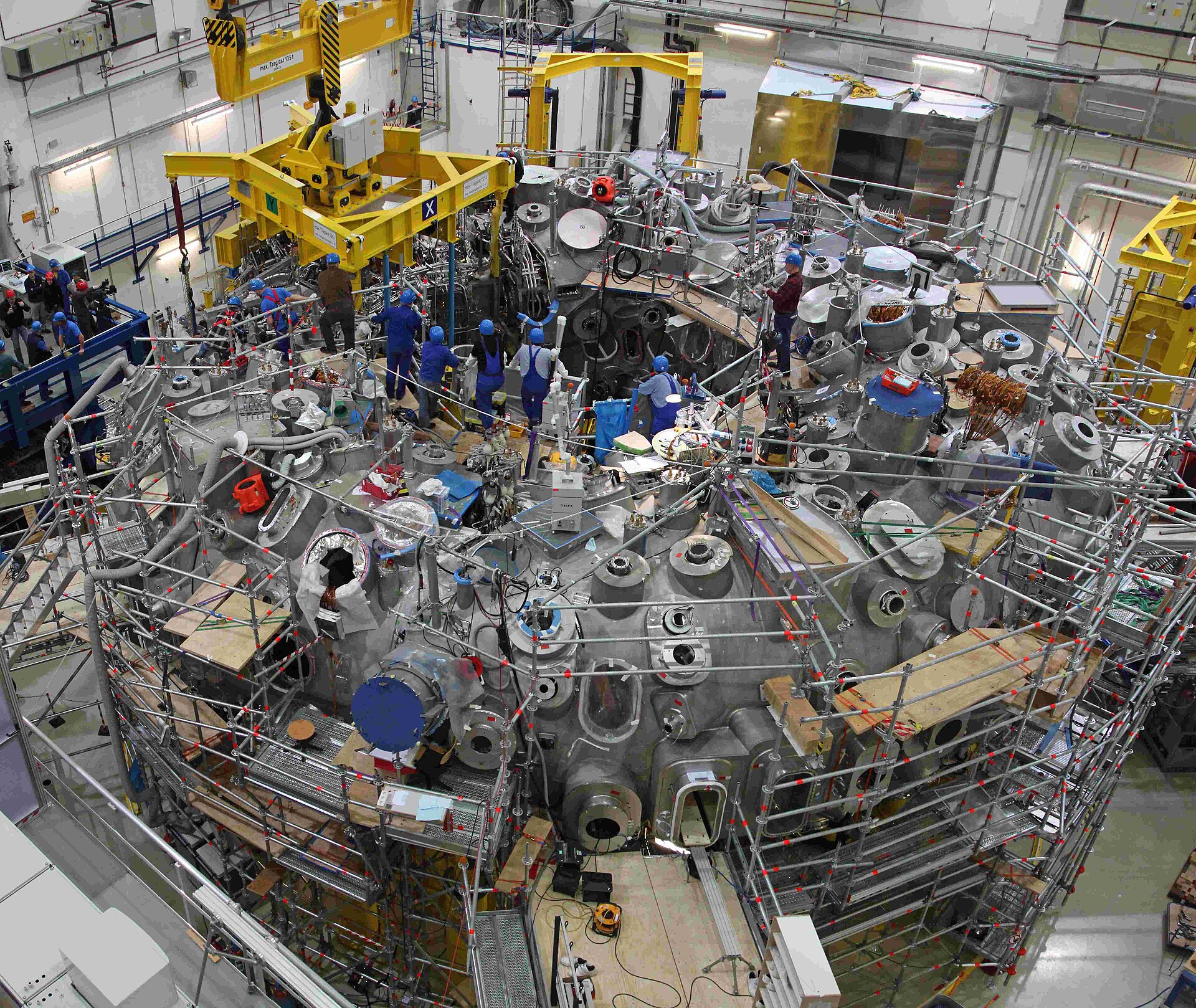


Proxima Fusion and three German suppliers have completed the first radial plate for the company’s Stellarator Model Coil, a prototype of the superconducting magnets its fusion machines will need, according to World Nuclear News. Many more plates are planned.
The radial plate is the structural base of the magnet. High-temperature superconducting cables are wound into it and held in place. For a stellarator, that plate is not flat.
Why Proxima Fusion plates are hard to make
Proxima Fusion is developing a quasi-isodynamic stellarator. In this design, the magnetic field that confines the plasma is shaped by coils with complex, non-planar three-dimensional forms. The plates that carry the superconducting cables follow the same shapes. Producing them to industrial quality and tolerance is one of the defining manufacturing challenges of the concept.
Francesco Sciortino, co-founder and chief executive of Proxima Fusion, said: “For stellarator magnets, the three-dimensional geometry is the key challenge in both design and manufacturing.”
Three suppliers, three steps
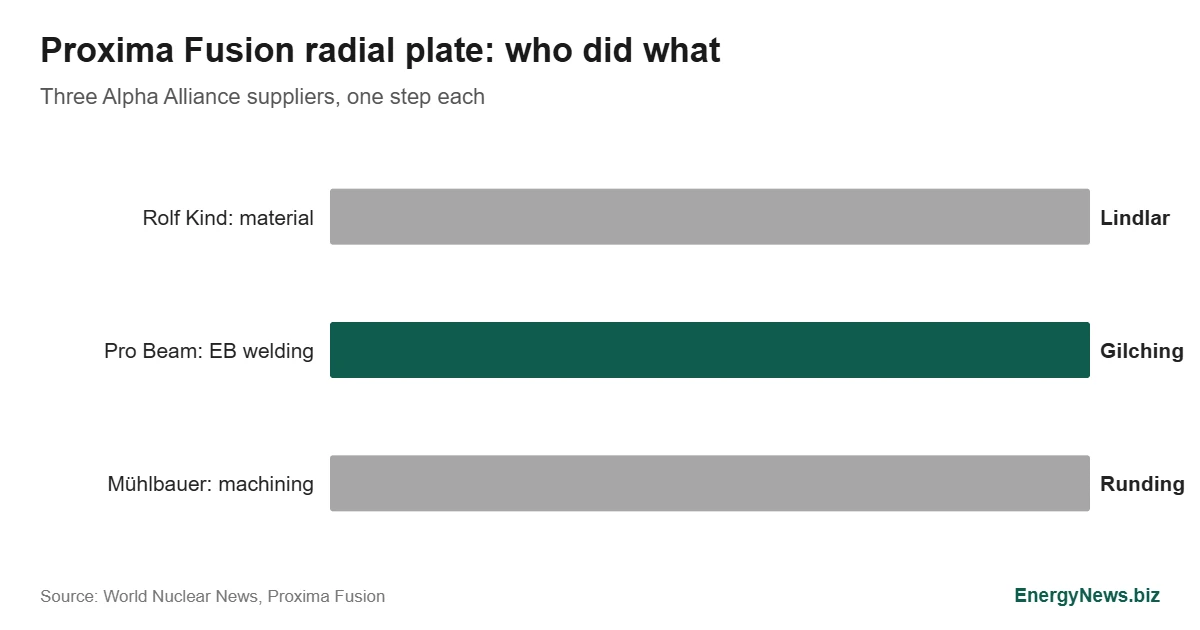
- Rolf Kind GmbH in Lindlar supplied the base material. Managing director Markus Kind said the component has to deliver extraordinary mechanical properties in later use.
- Pro Beam GmbH in Gilching joined the plate by electron beam welding, in what is described as the largest electron beam welding chamber in civil use. Managing director Thorsten Löwer said that in fusion, parts must carry big mechanical loads with very high accuracy.
- Mühlbauer Maschinenbau in Runding carried out the precision machining. Managing director Christoph Mühlbauer stressed that at least the final machining has to be right the first time.
All three belong to Proxima’s Alpha Alliance, a group of more than 50 industrial partners. The model is deliberate: fusion start-ups need suppliers that can move from one-off prototypes to repeatable production, and early involvement lets those suppliers learn and invest before volumes arrive.
From model coil to Alpha and Stellaris
The Stellarator Model Coil is a step towards Alpha, Proxima’s planned net energy gain demonstrator. Alpha is to be built near the Max Planck Institute for Plasma Physics in Garching. The company says it will be the first stellarator to demonstrate net energy gain once it operates in the 2030s.
The commercial plant, Stellaris, is planned at the former Gundremmingen nuclear power plant site in Bavaria, which RWE is decommissioning. In February 2026 Proxima signed a memorandum of understanding with the Free State of Bavaria, RWE and the Max Planck Institute for Plasma Physics for that project.
No funding figures or plate counts were given with the announcement. Proxima Fusion has raised venture funding and public support in recent years, and Germany has made fusion a priority in its research and industrial policy.
Germany’s fusion supply chain
The three suppliers come from different corners of German manufacturing: a materials and forging specialist, a welding service company and a machine builder. None is a nuclear company. That is typical of fusion supply chains, which draw on aerospace, semiconductor equipment and heavy engineering skills. Proxima Fusion’s bet is that by bringing these firms in early, through the Alpha Alliance, it can build a supply base in Germany before competitors in the United States, the United Kingdom and China lock up capacity for precision magnet structures.
Why it matters
Magnets are the core cost and risk item for magnetic confinement fusion. Tokamak developers can use planar coils, which are easier to make but need large plasma currents that bring their own stability problems. Stellarators avoid those currents but shift the difficulty into the magnet geometry. Each plate that comes out right first time is evidence that the shift is manageable. For precision manufacturers, it is also an early signal of a new market. In the near term, fission remains the main nuclear growth story, with plans such as New York’s 5 GW advanced nuclear goal.
What to watch
Watch for the completed Stellarator Model Coil and its test results at full field. A coil that reaches its design field without quench damage would be the strongest proof yet that Proxima Fusion can move from design studies to the hardware Alpha needs.
Add EnergyNews.biz as a preferred source on Google


