


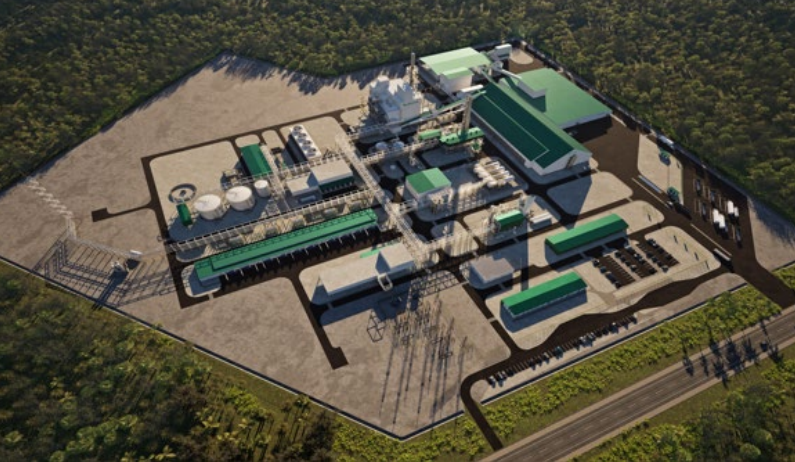


A $665 million final investment decision on a 260,000 tonne per year low-carbon fertilizer plant in Paraguay marks a notable inflection point for hydrogen-based industrial decarbonization. The Villeta project, led by ATOME PLC, is positioned as one of the first industrial-scale facilities to reach financial close based on commercial fundamentals rather than direct government subsidy support.
The project’s structure highlights a growing evolution in clean hydrogen economics. Financing includes $420 million in debt from multilateral and development institutions, coordinated by IDB Invest alongside the International Finance Corporation and the European Investment Bank, with the remaining $245 million in equity led by Hy24. The capital stack reflects a hybrid model where concessional and commercial finance converge to de-risk first-of-a-kind assets while maintaining market discipline.
At its core, the project targets a structural vulnerability in global agriculture. Nitrogen fertilizers support more than half of global food production, yet nearly all are currently produced using fossil fuels, primarily natural gas. This creates direct exposure to energy price volatility and geopolitical disruptions, which have repeatedly translated into fertilizer price spikes and downstream food inflation. By relying on Paraguay’s abundant hydropower, Villeta aims to decouple fertilizer production from fossil fuel inputs, producing calcium ammonium nitrate with significantly lower lifecycle emissions.
The scale of emissions reduction is material but context-dependent. The project is expected to avoid approximately 500,000 tonnes of CO2 equivalent annually and up to 12.5 million tonnes over its lifetime. While these figures are meaningful at the project level, they remain small relative to global fertilizer sector emissions, which are measured in hundreds of millions of tonnes per year. The broader relevance of Villeta therefore lies less in its immediate carbon impact and more in its potential as a replicable commercial model.
Geography plays a critical role in the project’s economics. Paraguay offers low-cost, baseload renewable electricity from hydropower, a key requirement for cost-competitive green hydrogen production. This positions the country as an outlier compared to regions where renewable intermittency or higher electricity costs remain barriers. At the same time, the plant’s location in the Mercosur region addresses another structural issue: Latin America is one of the world’s largest net importers of fertilizers, exposing agricultural systems to external supply disruptions.
The commercial viability of the project is further supported by a 10-year offtake agreement with Yara International, covering the plant’s full output. Long-term contracts of this nature are critical for securing financing in capital-intensive projects, particularly in emerging markets where revenue uncertainty can deter investment. However, such agreements also concentrate counterparty risk and depend on sustained demand for premium-priced low-carbon products.
From a technical standpoint, the integration of hydrogen into fertilizer production is not new. Ammonia synthesis has long relied on hydrogen as a feedstock, but traditionally sourced from natural gas through steam methane reforming. The shift to electrolytic hydrogen introduces higher production costs, driven primarily by electricity pricing and electrolyzer capital expenditure. The Villeta model attempts to offset these cost premiums through favorable energy inputs and economies of scale, though its competitiveness will remain sensitive to future energy and carbon pricing dynamics.
The project also illustrates the increasing role of development finance institutions in bridging the gap between pilot projects and industrial deployment. By taking on subordinated risk and mobilizing concessional funding, these institutions enable projects that may not yet meet purely commercial return thresholds. This raises broader questions about scalability. If similar projects require comparable financial structures, the pace of global deployment may be constrained by the availability of such capital.
ATOME’s positioning of Villeta as a template for decentralized fertilizer production introduces a potential shift in industry structure. Traditional fertilizer production is concentrated in regions with access to low-cost fossil fuels, often far from end markets. A distributed model based on renewable energy could reduce transportation costs and supply chain vulnerabilities, but it also depends on the availability of consistent, low-cost clean power, which remains unevenly distributed globally.
The transition from developer to operator marks a significant step for ATOME, but it also introduces execution risk. Delivering the project on time and within budget, with production targeted by 2029, will be critical for validating the commercial assumptions underpinning the model. Delays or cost overruns could affect investor confidence in similar projects, particularly given the capital intensity and technological integration required.
Add EnergyNews.biz as a preferred source on Google


