




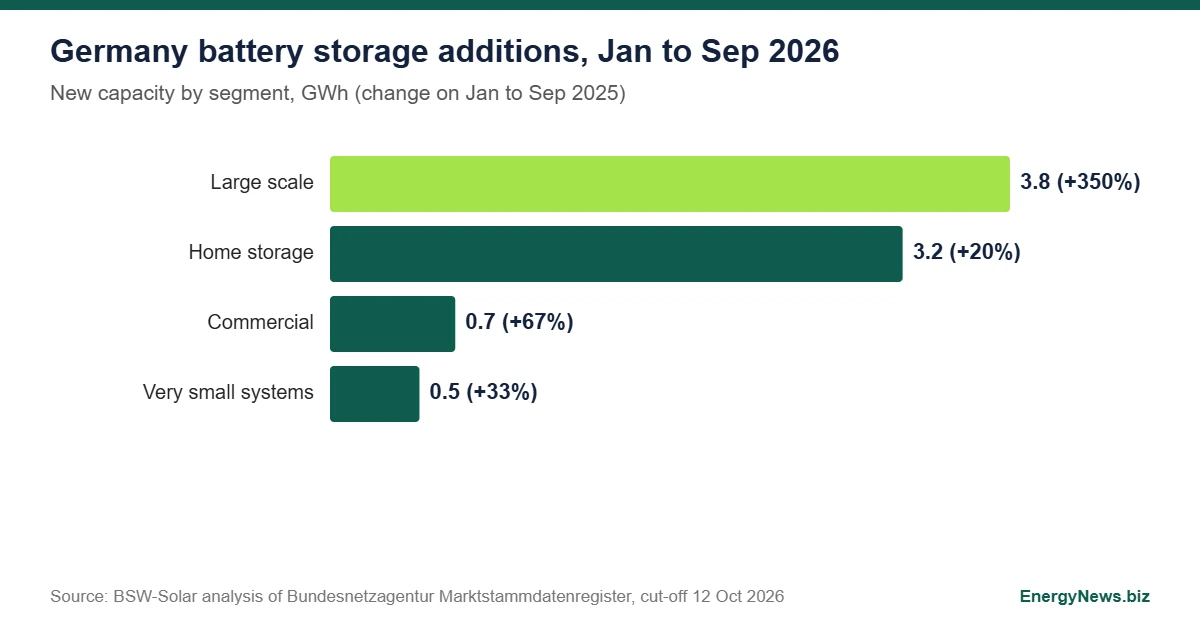
Germany battery storage additions reached about 8.2 GWh in the first nine months of 2026, up 91% on the same period of 2025, according to a BSW-Solar analysis of the Bundesnetzagentur’s Marktstammdatenregister, published on 22 October 2026. More than 500,000 new systems were registered. The cut-off was 12 October 2026, and late registrations can still raise the totals.
Germany battery storage by segment, January to September 2026
Large scale storage added about 3.8 GWh, more than quadrupled (roughly +350%), and now makes up about half of new capacity, so Germany battery storage is shifting from rooftops to substations. Home storage added about 3.2 GWh (+20%), commercial storage about 0.7 GWh (+67%) and very small systems about 0.5 GWh (+33%). The figures are energy capacity in GWh; the release gives no power figures in GW.
| Segment | 2026 (GWh) | Change | Implied 2025 (GWh, ENB calculation) |
|---|---|---|---|
| Large scale | 3.8 | +350% | 0.84 |
| Home storage | 3.2 | +20% | 2.67 |
| Commercial | 0.7 | +67% | 0.42 |
| Very small systems | 0.5 | +33% | 0.38 |
| Total | 8.2 | +91% | 4.29 |
Implied 2025 values are the 2026 value divided by one plus the published change, so they carry the rounding of the published percentages (the segments sum to 4.31 against 4.29 for the total).
What the Germany battery storage numbers imply
ENB calculation: large scale systems were about 20% of additions in the first nine months of 2025 (0.84 of 4.29 GWh) and are about 46% in 2026 (3.8 of 8.2 GWh). Of the 3.9 GWh increase in total additions (8.2 minus 4.29), large scale accounts for 2.96 GWh, about 76%, and home storage for 0.53 GWh. The growth in Germany battery storage is mostly a utility scale story, even though home systems still supply 3.2 GWh.
BSW-Solar expects well over 10 GWh of new storage capacity in 2026. Nine months at 8.2 GWh average 0.91 GWh a month, so the same pace over twelve months gives about 10.9 GWh. Reaching 10 GWh needs 1.8 GWh in the last quarter, against 2.7 GWh at the average pace, so the forecast needs no acceleration. Single projects give a sense of scale: Sumitomo’s 62 MW, 291 MWh battery at Namie in Fukushima holds 0.29 GWh and Orsted’s Iceni battery 0.6 GWh, so the 3.8 GWh of large scale Germany battery storage added in nine months equals about six Iceni sized batteries (ENB calculation).
BSW-Solar’s reform demands and the Fraunhofer IEE figures
BSW-Solar calls for a storage booster of 15 reform measures; the release lists three. Storage would be easier to operate jointly with solar and wind plants and at consumption sites, with a right to fair, flexible grid connection agreements. Distribution grid operators would be obliged to tender grid supporting storage at substations. Redispatch would apply control at the grid connection point instead of at individual generators, so that surplus solar can be stored instead of curtailed. Carsten Körnig, the association’s managing director, says the federal government lacks clear responsibility, binding expansion targets and an overarching storage strategy, and that battery storage has to become a matter for top level attention.
The release also cites Fraunhofer IEE. Additional storage of 80 GWh in the previous year could have relieved consumers and the federal budget by almost €4 billion, a potential saving and not a realised one. Through 2030 the grid would need four to five times today’s annual additions of flexibility to integrate renewables cost effectively, and storage at substations could roughly double the PV capacity connected to distribution grids under the conditions studied. ENB calculation: 80 GWh is about ten times the 8.2 GWh of Germany battery storage registered so far in 2026.
The next dated check is the full 2026 registry total for Germany battery storage, which BSW-Solar has put at well over 10 GWh, once late registrations for the year are in.
Add EnergyNews.biz as a preferred source on Google


