




Next Hydrogen Solutions, a Canadian maker of alkaline electrolysers, and H2 Manufacturing, a Tulsa, Oklahoma, company that builds compression, storage and fuelling equipment, have agreed a strategic collaboration to offer complete distributed hydrogen systems across North America. The non-exclusive agreement was announced on 25 November in a joint release.
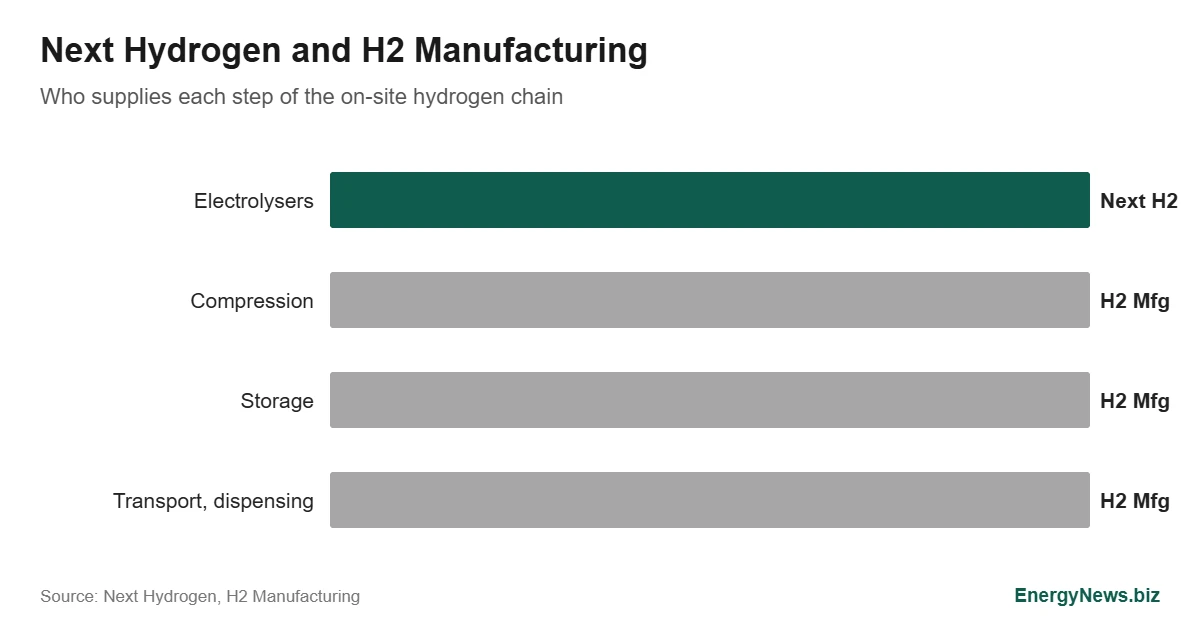
The idea is to sell customers one package instead of separate pieces: Next Hydrogen electrolysers combined with H2 Manufacturing’s compression, dispensing, storage and balance-of-plant equipment.
What Next Hydrogen and H2 Manufacturing will offer
The companies describe a one-stop solution covering production, compression, storage, distribution and dispensing. Systems are modular, designed to scale with demand and to use renewable, intermittent or stranded electricity when available.
Target applications include hydrogen trains, buses and trucks, distribution centres, fertiliser production, industrial sites, agriculture, local fuelling stations and hydrogen infrastructure along highway corridors.
Stephen Griggs, executive chair of Next Hydrogen, said: “North American customers increasingly want complete hydrogen solutions.” Michael Koonce, chief executive of H2 Manufacturing, pointed to the value of a modular electrolyser that can scale with customer demand. Jocelyne Moyer, president and chief executive of Next Hydrogen, called the collaboration an important milestone.
The financing angle
H2 Manufacturing is affiliated with GTL Leasing, which describes itself as North America’s largest high-pressure gas transport leasing company, with a large fleet of hydrogen and CNG trailers. GTL is controlled by Antin Infrastructure Partners, a Paris-based infrastructure investor. Many projects under the collaboration are expected to consider GTL financing.
That matters more than the equipment list. Small and medium hydrogen users rarely want to own electrolysers, compressors and tanks outright. A leasing or hydrogen-as-a-service model, backed by an infrastructure fund, can turn a capital purchase into a monthly cost, which is how industrial gases have long been sold.
What the announcement leaves out
The release gives no financial figures, capacities, orders or project counts. It does not say what size of electrolyser the package starts at, or at what hydrogen price the partners expect to compete with delivered hydrogen from steam methane reforming.
The timing is also difficult. US hydrogen support has weakened since the shortened runway for the 45V tax credit, and several regional hydrogen hubs face uncertainty. Next Hydrogen itself reported third quarter results on 17 November and proposed an extension of its debentures, a sign of the financial pressure on smaller electrolyser makers.
Who Next Hydrogen competes with
Next Hydrogen competes with larger electrolyser makers that also target small and medium systems, as well as with industrial gas companies that deliver hydrogen by truck or pipeline under long contracts. Its argument is the alkaline stack design, which the company says handles variable power well, combined with a partner that already moves hydrogen across the continent. For customers, the practical test will be uptime and service response, since an on-site system that fails leaves a fleet or a plant without fuel. That makes the service network of H2 Manufacturing and GTL as important as the electrolyser itself.
Why it matters
Distributed production is one answer to the main cost problem of hydrogen: delivery. Trucking compressed hydrogen over long distances can cost as much as producing it. Making hydrogen on site, near the user, removes that cost, but it needs compact, reliable equipment and someone to finance and maintain it. Partnerships like this one try to supply both. Large central projects face a different test, as the thyssenkrupp Steel hydrogen tender showed.
What to watch
Watch for the first named customer and the size of its system. A signed order with GTL financing for a fleet depot or a fertiliser site would show whether Next Hydrogen and its partner can turn the one-stop offer into revenue.
Add EnergyNews.biz as a preferred source on Google


