



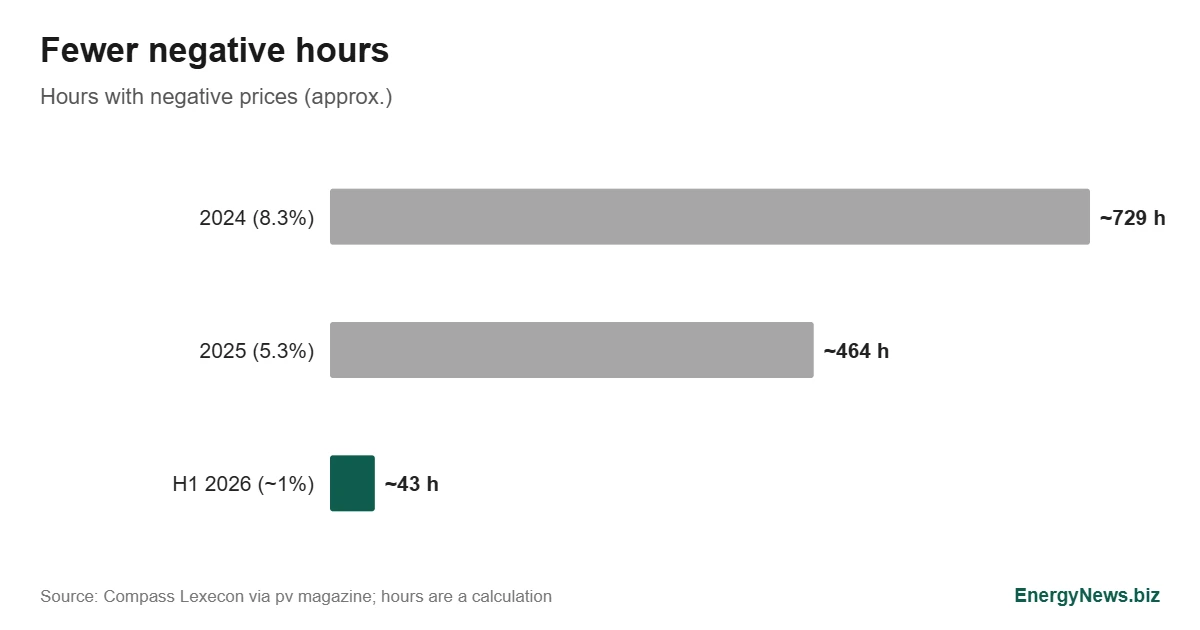
Negative electricity prices have become one of the most quoted symptoms of Europe’s fast solar build-out, but the trend has turned. A study by consultancy Compass Lexecon finds that negative prices occurred in 8.3% of hours in 2024, fell to 5.3% in 2025 and stood at about 1% in the first half of 2026. Spain and the Netherlands each saw negative prices in roughly 7% of hours in 2025.
The study argues that negative prices are not necessarily a failure of the market. When they reflect real supply and demand, they direct investment towards storage, demand-side flexibility and electrification.
Negative electricity prices in hours
Percentages hide the scale, so a calculation helps. With 8,784 hours in the leap year 2024, 8.3% equals about 729 hours of negative prices. In 2025 the 5.3% share equals about 464 hours. In the first half of 2026, about 1% of roughly 4,344 hours is around 43 hours. In other words, the number of negative hours in a half year has dropped to a level that 2024 reached in a few weeks of spring.
The figures are averages across markets, and the first half of 2026 includes winter months with less solar, so the full-year number will be higher. The direction is still clear.
Why negative electricity prices are falling
The main reason is that flexibility is finally arriving at scale. Batteries charge in exactly the hours when prices go negative, which lifts those prices towards zero. Germany alone has several gigawatt hours of new storage moving towards construction, and markets such as Spain and the Netherlands are seeing similar growth. Rule changes also help: newer support schemes stop paying generators when prices are negative, so solar parks curtail instead of producing into a negative market.
Demand is part of it too. Electric vehicles, heat pumps and industrial users with flexible processes can move consumption into cheap hours. Every flexible kilowatt that shifts to midday removes some of the surplus that drives prices below zero.
Negative electricity prices by country
The picture differs by market. Spain and the Netherlands, with high solar shares and limited interconnection at midday, remained near the top in 2025 at around 7% of hours. Countries with more flexible hydropower, stronger cross-border links or faster battery growth saw negative electricity prices stabilise or fall. Others are still on an upward trend, so national averages can hide local pressure points.
That matters for anyone choosing where to build storage. Markets where negative electricity prices are still frequent offer bigger daily spreads, but they also attract the most competition, and spreads can collapse once enough batteries are connected. Planning on today’s price pattern for a fifteen-year asset is the most common mistake in early storage business cases.
What the trend means for investors
Falling negative hours are good news for consumers and for system stability, but they shrink one revenue source for storage: buying power at negative prices. The study notes that European flexibility needs could still double by 2033, according to estimates from ENTSO-E, driven by renewable growth and electrification. The opportunity moves from capturing extreme price events to providing reliable daily shifting and system services.
Compass Lexecon recommends three actions: limiting support mechanisms that distort incentives, removing barriers to flexible resources entering markets, and using extra procurement only where market-driven investment falls short. That fits the direction set by the EU permitting deal for storage and grids.
The number to watch is the full-year 2026 share of negative hours. If it stays far below 5%, Europe’s flexibility build-out is outpacing solar growth. The underlying data comes from the European power exchanges and ENTSO-E.
Add EnergyNews.biz as a preferred source on Google


