


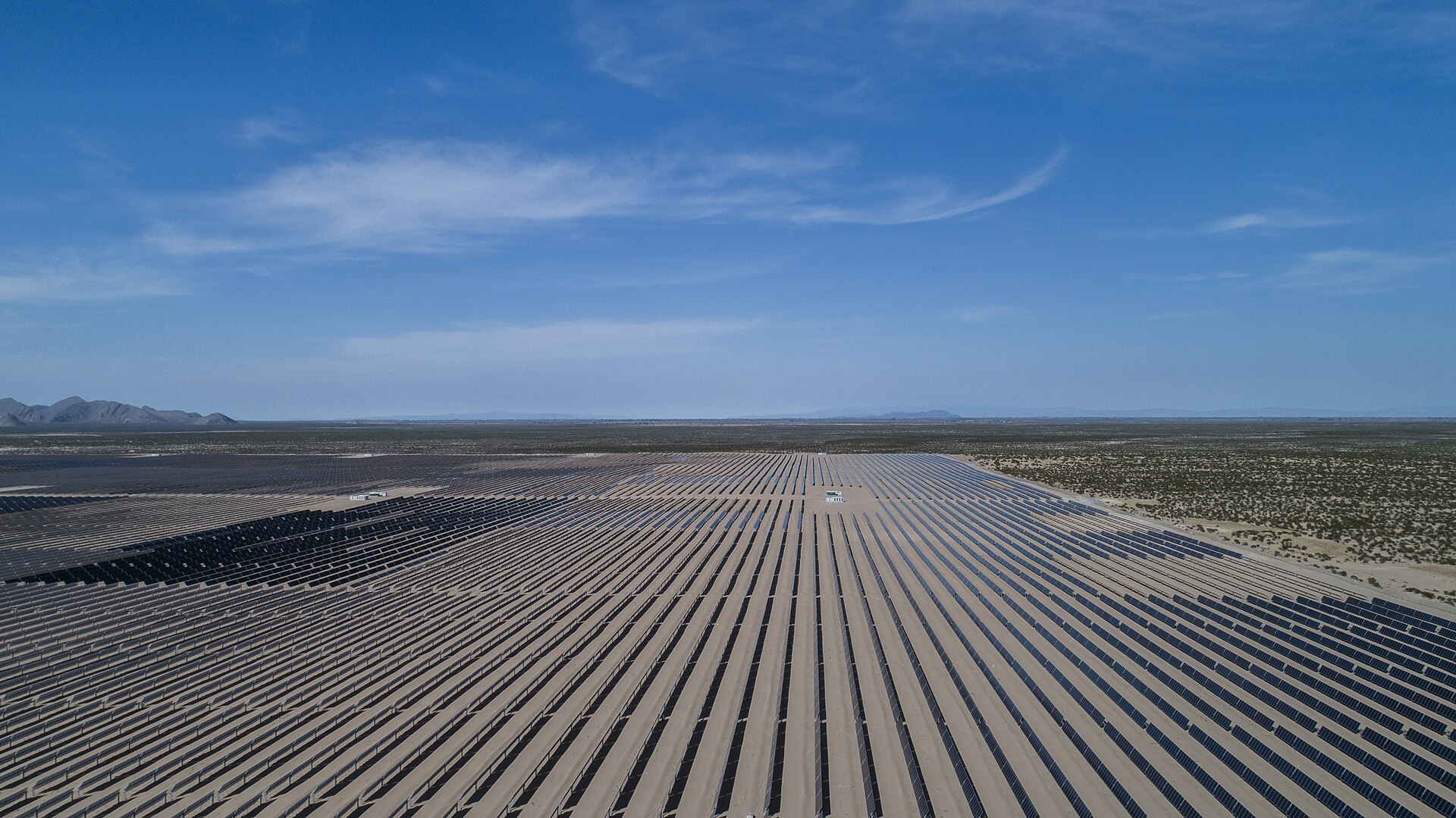


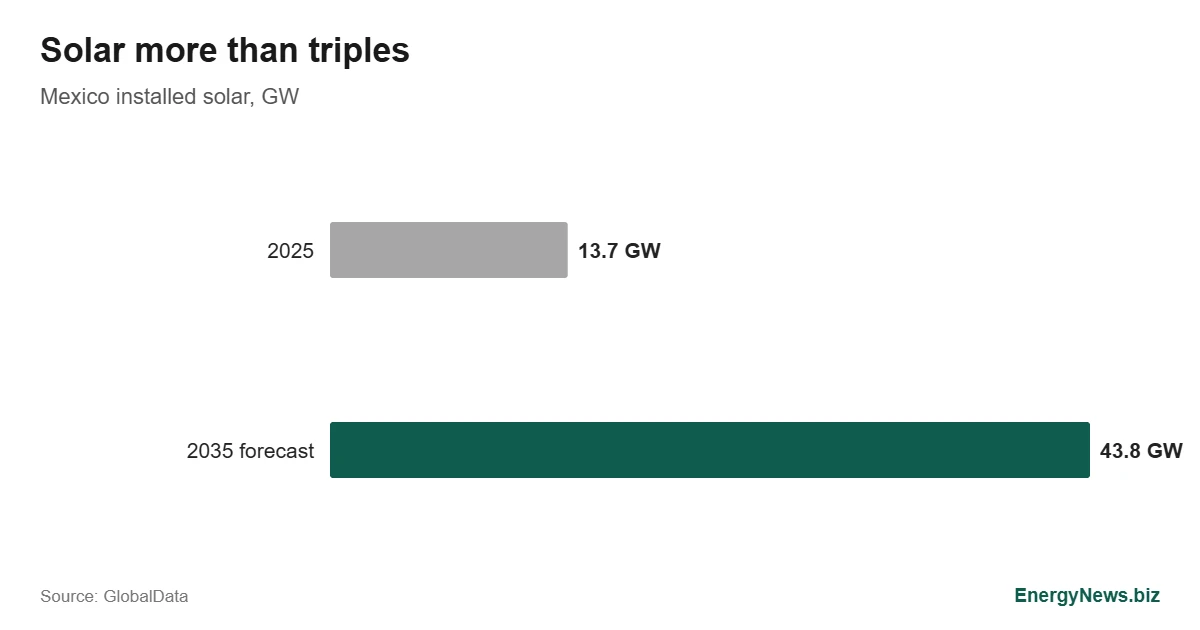
Mexico solar capacity could grow from 13.7 GW in 2025 to 43.8 GW by 2035, according to a new report on the Mexican electricity market by research firm GlobalData. The forecast is 6 GW higher than the firm’s December 2025 projection of 37.8 GW.
GlobalData expects renewables to make up 42.3% of Mexico’s installed power capacity by 2035, up from 22.9% in 2025. Total capacity is forecast to rise from 104.2 GW to 156 GW over the period, a compound annual growth rate of 4.1%.
Mexico solar in numbers
An ENB calculation shows what the forecast requires. Adding about 30 GW over ten years means an average of roughly 3 GW of new solar every year, and the fleet would grow about 3.2 times. That is a much faster pace than Mexico achieved during the years when private renewable investment slowed under earlier policy changes.
Generation lags capacity. GlobalData projects the renewable share of electricity generation rising from 14.5% to 31.9% by 2035, while thermal plants still provide nearly 60% of generation. Electricity consumption is forecast to rise from 328.5 TWh to 423.2 TWh, driven by industrial nearshoring, data centres and air conditioning.
The new rules behind the forecast
GlobalData analyst Attaurrahman Ojindaram Saibasan said the 2025 Electricity Sector Law and the binding 2025-2039 Electricity Sector Development Plan, known as PLADESE, have reshaped Mexico’s investment landscape. The framework guarantees the state at least 54% of the electricity injected into the grid and gives a central role to mixed-investment projects between the Federal Electricity Commission (CFE) and private companies.
For private developers, that means many of the largest projects will be partnerships with CFE rather than purely merchant plants. The upward revision suggests the market sees enough room within those rules for solar to grow quickly.
Mexico solar and the grid
Transmission is the main bottleneck. Many of the best solar sites are in the north and northwest, far from the industrial centres of the Bajío and the capital. Without new lines, more solar risks curtailment at midday. PLADESE includes transmission investment, and the pace of that build-out will largely decide whether the 43.8 GW forecast is reached.
Storage is the second lever. Batteries at solar plants and at industrial sites can move midday output into the evening peak, when air conditioning demand stays high. Mexico has started to require storage for some new projects, and the share of solar paired with batteries is likely to rise as costs fall.
For investors, the forecast signals a large market, but one shaped by state partnership. Mexico solar developers that can work with CFE on mixed projects, and that bring financing and technology, are best placed to capture the growth. Distributed solar on factory roofs adds a further layer, as nearshoring plants look for ways to cut daytime power bills and meet the clean energy requirements of their customers in the United States.
Why Mexico solar growth matters
Nearshoring is bringing factories closer to the US market, and those factories need reliable, competitively priced power. Solar is the cheapest new generation in much of Mexico, and the northern states have some of the best solar resources in the Americas. Grids will be the constraint, as they are worldwide, a point made in the analysis of global grid expansion. The same pattern of solar leading new supply is set out in the IEA outlook covered in solar becoming the largest source.
The next data point will be Mexico’s annual capacity additions for 2026, which will show whether the market is on the 3 GW a year path the forecast implies. The forecast is published by GlobalData.
Add EnergyNews.biz as a preferred source on Google


