


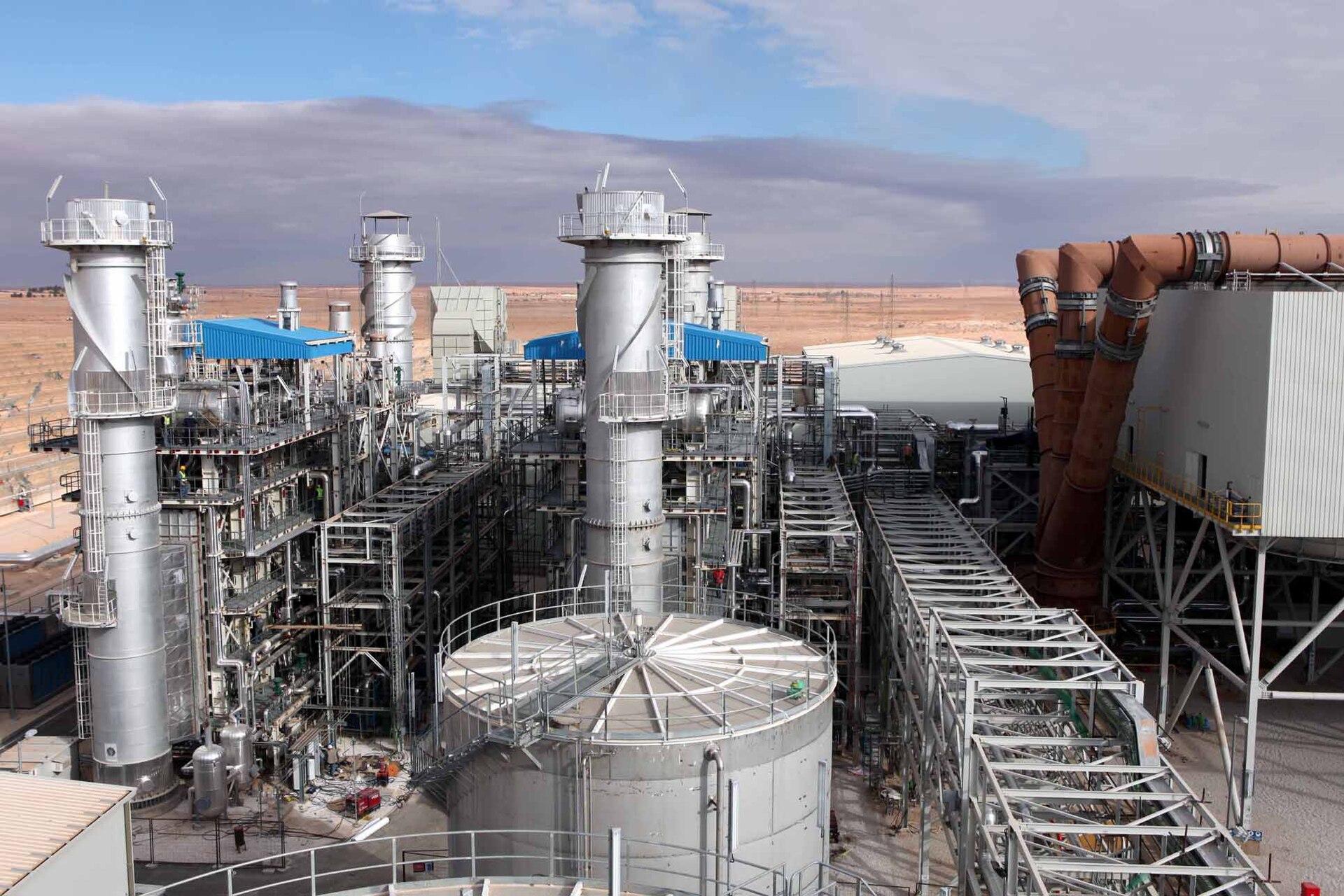


Algeria solar capacity has passed 1 GW for the first time. According to Rystad Energy, quoted by pv magazine, the country added about 760 MW this year. That is a big step for a power system that still runs almost entirely on natural gas. It is also well short of what the government said it would build in 2026, and far below the pace needed for its own 2035 goal.
The milestone matters for anyone selling modules, inverters or construction services in North Africa, because the gap between plan and delivery decides how many tenders will follow and how fast.
The Algeria solar story also shows how quickly a gas exporter can change course once the state commits. Ten years ago, Algeria solar capacity was a few hundred megawatts and barely grew.
Algeria solar in 2026: plan versus delivery
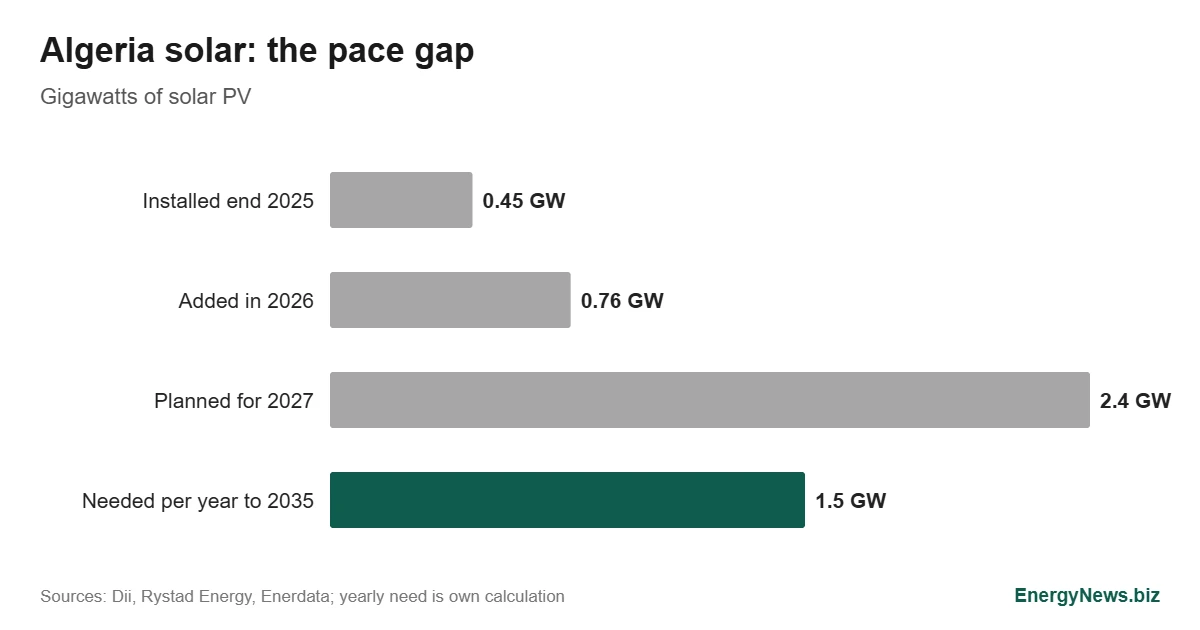
At the end of 2025, the research group Dii put Algeria’s installed renewable capacity at about 446 MW. In May 2026 two plants with a combined 400 MW were commissioned, which roughly doubled the solar fleet. In October the 300 MW Foulia plant, the largest in the country, was inaugurated.
Those projects belong to a 3.2 GW programme of 22 plants. The government said it wanted 1.4 GW of new capacity online by the end of 2026. Rystad’s figure of about 760 MW means roughly 54% of that goal was delivered. The rest has slipped into 2027, when the energy minister says 17 projects with 2.4 GW are due to enter service.
The 2035 calculation
The national target is 15 GW of solar PV by 2035. Starting from about 1.2 GW today, Algeria needs roughly 13.8 GW more in nine years. That is an average of about 1.5 GW every year from 2027 to 2035, or twice the 2026 result.
The 2027 plan of 2.4 GW would be more than three times this year’s additions. Looked at this way, the Algeria solar programme is no longer a question of announcements. The tenders exist and the sites are chosen. The test is execution: grid connections, financing and the speed of the state companies that run most of the projects.
Why gas makes the case for Algeria solar
Natural gas produced about 99% of Algeria’s electricity in 2024, according to Enerdata. Every unit of power from solar is gas that can be exported instead of burned at home.
A rough calculation shows the scale. Assume each kilowatt of solar in Algeria produces about 1,900 kWh a year, which fits the country’s high irradiation, and that a gas plant converts fuel to power at around 45% efficiency. Then 1 GW of solar saves about 4.2 TWh of gas a year, or roughly 0.4 billion cubic metres. At 15 GW, the saving would be around 6 billion cubic metres a year. That is gas that could earn export revenue in Europe, which helps explain why the state is pushing the programme despite its fiscal limits.
For comparison, other African markets are moving in smaller steps. A recent 50 MW solar plant in Zambia reached financial close this month. Algeria’s projects are larger, but most rely on public money rather than private finance.
What suppliers should watch
Three points stand out. First, the delivery rate in 2026 suggests suppliers should plan for delays of six to twelve months on any Algerian project. Second, the 2027 target is large enough to create a supply bottleneck in local construction capacity. Third, grid connection is the usual bottleneck in fast solar programmes, so suppliers that can bring substations and transmission work as part of a package will have an edge.
The number to watch
The number to watch is how much of the 2.4 GW planned for 2027 is connected by the end of next year. If Algeria delivers more than 1.5 GW, the 2035 goal stays realistic. If it repeats this year’s rate of roughly half the plan, the target will slide well past 2035, and the next wave of Algeria solar tenders will likely be smaller.
Add EnergyNews.biz as a preferred source on Google


