





The EU UK ETS link is no longer a political intention. On 20 November the European Commission and the UK government concluded negotiations to link their emissions trading systems, with the aim of applying the agreement from January 2028, subject to ratification and entry into force on both sides. From that date an allowance issued in either system would count for compliance in the other.
The headline expectation of the EU UK ETS link is that UK carbon prices rise to EU levels. That is true for the allowance itself. For UK gas power plants, the more important change may be the planned end of a separate British carbon tax, which on current prices would leave their total carbon bill lower than today.
What the EU UK ETS link agreement contains
Under the EU UK ETS link, the two systems stay institutionally separate but follow aligned rules. According to the Commission, as summarised by Enerdata, the link should create a larger and more liquid market and reduce the price difference between EU and UK allowances. The EU keeps its existing link with Switzerland, in place since 2020.
The UK will extend its ETS to aviation and maritime transport, adding more than 10 million tonnes of CO2 a year. Both sides will monitor the non-CO2 climate effects of aviation. The EU ETS covers about 40% of EU emissions and the UK system about 25% of UK emissions, according to a Reuters explainer.
Two border measures sit behind the EU UK ETS link. The EU Carbon Border Adjustment Mechanism entered its definitive phase in January 2026 and charges importers of steel, cement, aluminium, fertilisers, electricity and hydrogen. The UK launches its own CBAM on 1 January 2027 for the same sectors except electricity. London intends to exempt EU, EEA and Swiss goods from its CBAM from day one; the EU exemption for UK goods is expected from January 2028 and needs a delegated act amending the CBAM regulation.
Five numbers that define the EU UK ETS link starting point
| Item | Value | Source |
|---|---|---|
| EU allowance, EEX auction 23 Nov 2026 | €83.06 (about £69.50) | EEX via carbonprice.co.uk |
| UK allowance, October 2026 average | £63.94 | UK ETS Authority |
| UK Carbon Price Support for power | £18 per tonne, signalled to end April 2028 | Reuters |
| UK exports exposed to EU CBAM | £6.5 billion (government), £7 billion (Reuters) | UK government, Reuters |
| Estimated saving for UK industry | about £800 million a year | Energy UK |
The two export figures differ. The UK government’s own publication uses £6.5 billion, while Reuters, citing the government, reported £7 billion. Both describe the value of UK goods that would face the EU border charge without a link.
The allowance price: how far UK prices must move
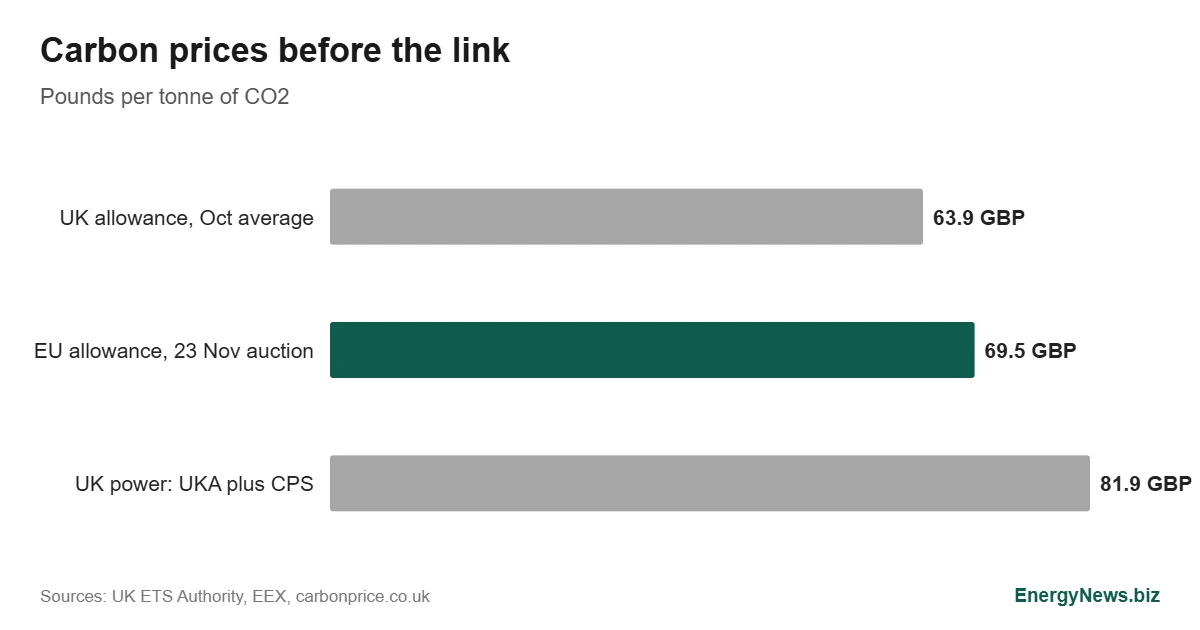
On the October average, UK allowances traded at £63.94 against an EU auction price equal to about £69.50 on 23 November. Closing that gap means a rise of about 9% for UK allowances. On the Reuters market prints of 20 November, about £60 for the UK and €82 for the EU, the required rise is closer to 14%.
Much of the move has already happened. In December 2025 the spread was around $23 per tonne, according to S&P Global; it narrowed sharply as the link became likely. Energy Aspects expected the spread to fall below €10 per tonne by the end of 2026 and full alignment once linking takes effect. Traders who bought UK allowances on the linking story have mostly been paid already.
The power plant calculation
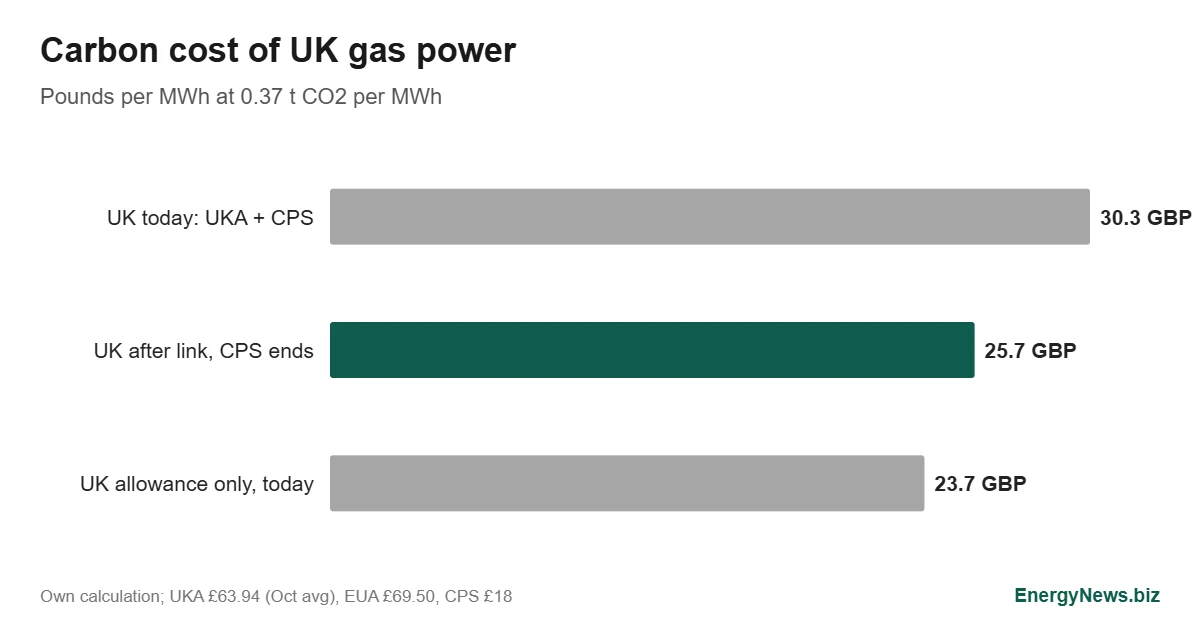
For UK power generators the allowance price is only part of the bill. Fossil fuel generators also pay the Carbon Price Support, a separate tax of £18 per tonne. The government has signalled that it will end in April 2028, close to the start of the link.
The calculation uses a modern combined cycle gas plant emitting 0.37 tonnes of CO2 per MWh of electricity.
- Today: (£63.94 + £18) × 0.37 = about £30.30 per MWh.
- After linking, with the support ended and the UK price at the current EU level of £69.50: £69.50 × 0.37 = about £25.70 per MWh.
- Difference: about £4.60 per MWh, or 15% less carbon cost.
In a market where gas plants still set the price in many hours, a lower carbon cost for the marginal plant feeds into wholesale prices. The effect is modest next to swings in gas prices, but it runs against the common assumption that linking makes British power more expensive. The result depends on two things that are not yet law: the end of the support in 2028 and an EU price that stays near current levels.
Sensitivity matters for any EU UK ETS link estimate. Every £10 move in the EU allowance price changes the post-link carbon cost of a gas plant by £3.70 per MWh. If EU prices rose to about £82 per tonne, the post-link cost would equal today’s combined UK charge, and the saving would disappear.
What changes for exporters and industry
For energy-intensive exporters the main gain is not the carbon price but the removal of border paperwork and charges. A UK steel or aluminium exporter selling into the EU faces CBAM reporting and, without exemption, a charge linked to the difference between EU and UK carbon prices. With a link and mutual exemption, that disappears.
The cost is a higher allowance price at home. UK industrial users already pay some of the highest electricity prices in Europe: official UK statistics show large non-domestic users paying 23.37 pence per kWh in the second half of 2025, against an EU-plus-UK median of 11.39 pence. A higher UK allowance price adds to the cost of directly emitted CO2 for these users, which is why the free allocation rules and any compensation scheme still to be aligned will matter more than the headline link. How price signals already reshape European power markets is shown in the German redispatch data.
What the EU UK ETS link means for traders and compliance teams
For compliance buyers, the EU UK ETS link changes the planning horizon. The agreement allows allowances from either system to be used for surrender obligations covering 2027 emissions, which fall due in 2028. A UK installation that would otherwise buy UK allowances in 2027 can weigh EU allowances as an alternative once ratification is certain, and vice versa. Treasury teams should check whether their registries, contracts and hedging books can hold both types of unit.
For traders, liquidity is the main prize. The EU market is many times larger than the UK market, and the UK auction calendar is thin by comparison. A linked market should narrow bid and offer spreads for UK participants and reduce the risk of sharp moves around single UK auctions. The flip side is that UK prices will start to react to EU politics, from Market Stability Reserve decisions to changes in EU free allocation and CBAM.
For power generators, the EU UK ETS link is one of three changes arriving close together in 2027 and 2028: the UK CBAM from January 2027, the planned end of the Carbon Price Support in April 2028 and the link itself. Contract terms for long-term power purchase agreements signed now should state clearly who carries the carbon cost under each scenario.
For the climate effect, the question is the cap. Linking two systems does not cut emissions by itself; it moves abatement to where it is cheapest across both markets. The real test of ambition is the UK cap trajectory after 2030 and the size of the aviation and maritime extension, which together decide how many allowances enter the joint market.
What can still go wrong
- Ratification. The agreement needs approval in both the EU and the UK. A change of government in London or delays in the European Parliament could push the start beyond January 2028.
- Cap alignment. The Commission has stressed that the UK cap trajectory must be at least as ambitious as the EU’s. Any loosening would flood the linked market with cheaper allowances.
- CBAM timing. The EU exemption for UK goods depends on full linking and a delegated act; until then UK exporters keep reporting.
- Political opposition. The Conservative party opposes closer EU ties and wants carbon levies removed, which makes the link a live issue before the next UK general election.
The number to watch
For the EU UK ETS link, the number to watch is the spread between EU and UK allowance prices, now about £5.50 to £8.50 per tonne depending on the reference. If it closes before ratification, the market is pricing the EU UK ETS link as certain. If it widens again, traders are pricing political risk, and UK generators and exporters should plan for a later start.
Add EnergyNews.biz as a preferred source on Google


