


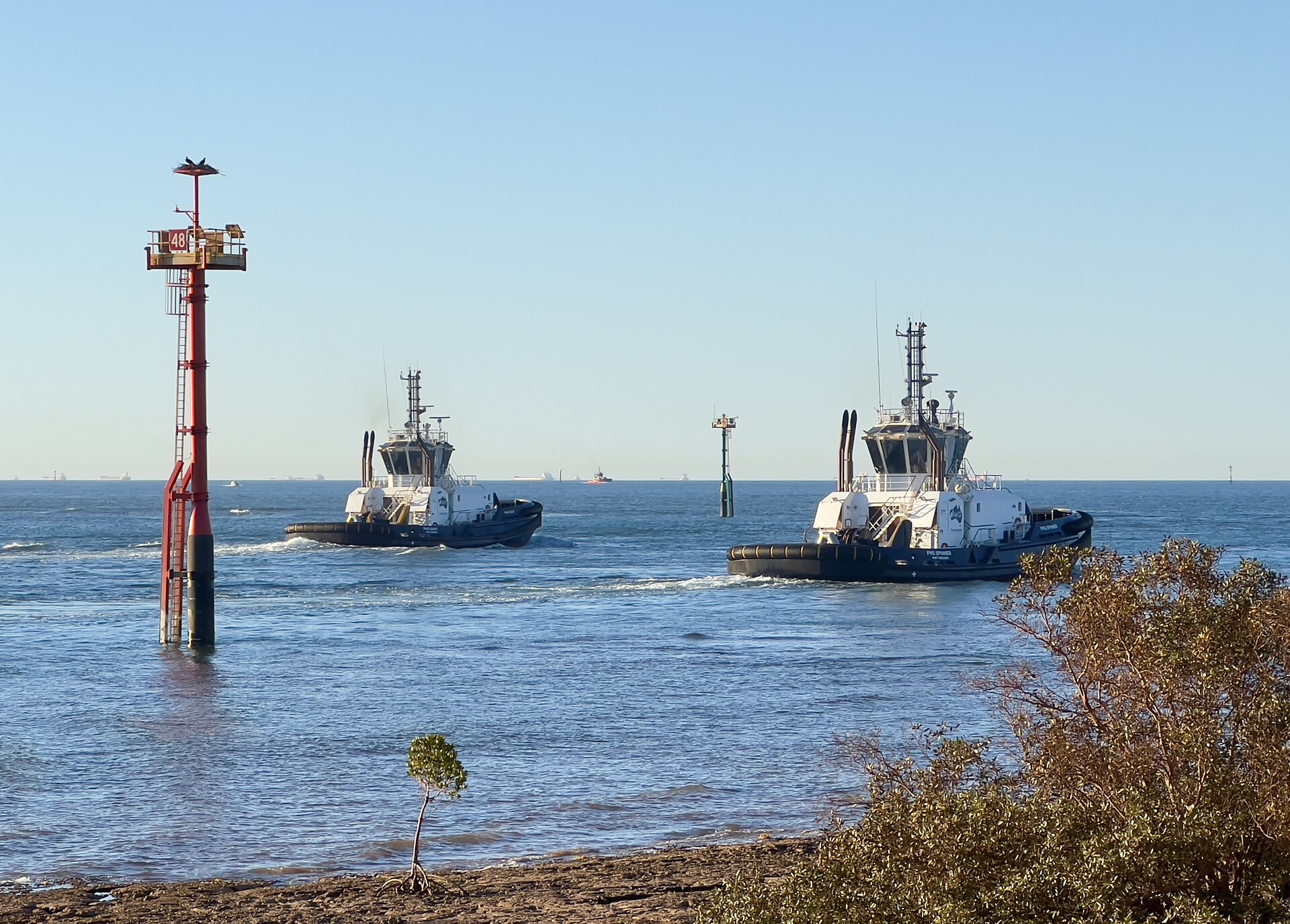


Port Hedland, one of the largest iron ore loading ports in the world, could become a supply point for green ammonia fuel. InterContinental Energy’s Australian Renewable Energy Hub (AREH), a wind and solar project proposed at up to 26 GW, has signed a joint development agreement with Pilbara Ports to advance green ammonia bunkering and bulk exports through the port, the partners said on 11 November 2026.
The agreement arrives days after green ammonia was transferred ship to ship for the first time at Port Hedland. The question it raises is not technical but volumetric: how much ammonia an iron ore fleet would need, and how much of AREH’s power would go to making it.
What AREH and Pilbara Ports agreed for Port Hedland
AREH is a phased project in Western Australia’s Pilbara region. Its developer has already offered low-cost power for up to 5 GW of data centres and plans to produce renewable hydrogen and derivatives. The joint development agreement covers how future ammonia production could connect with port infrastructure and with demand for marine fuel.
“It will help us understand how production could connect with port infrastructure and marine fuel demand as AREH scales up,” said Isaac Hinton, chair of AREH and head of Australia at InterContinental Energy. Samuel McSkimming, chief executive of Pilbara Ports, said the agreement would help define the infrastructure and services needed for green ammonia bunkering and bulk exports at Port Hedland.
Port Hedland bunkering trials so far
Earlier in November, green ammonia was bunkered to the Mineral Europa, a vessel chartered by Fortescue and described as the world’s first ammonia-powered dry bulk carrier, before it loaded iron ore at Port Hedland. That followed ship-to-ship ammonia transfer trials in the Port of Dampier. McSkimming said the new agreement would lay the foundations for a commercially viable clean fuel supply chain at Port Hedland.
The trials sit within the Pilbara Clean Fuel Bunkering Hub initiative, which aims to build a locally supplied clean marine fuel industry for shipping, maritime and resources activities, including vessels on the Pilbara to North Asia trade route. Pilbara Ports estimates that switching the iron ore fleet serving its ports from heavy fuel oil to low-carbon ammonia could cut annual lifecycle fuel emissions by up to 88%.
Twice the tonnage in the tanks
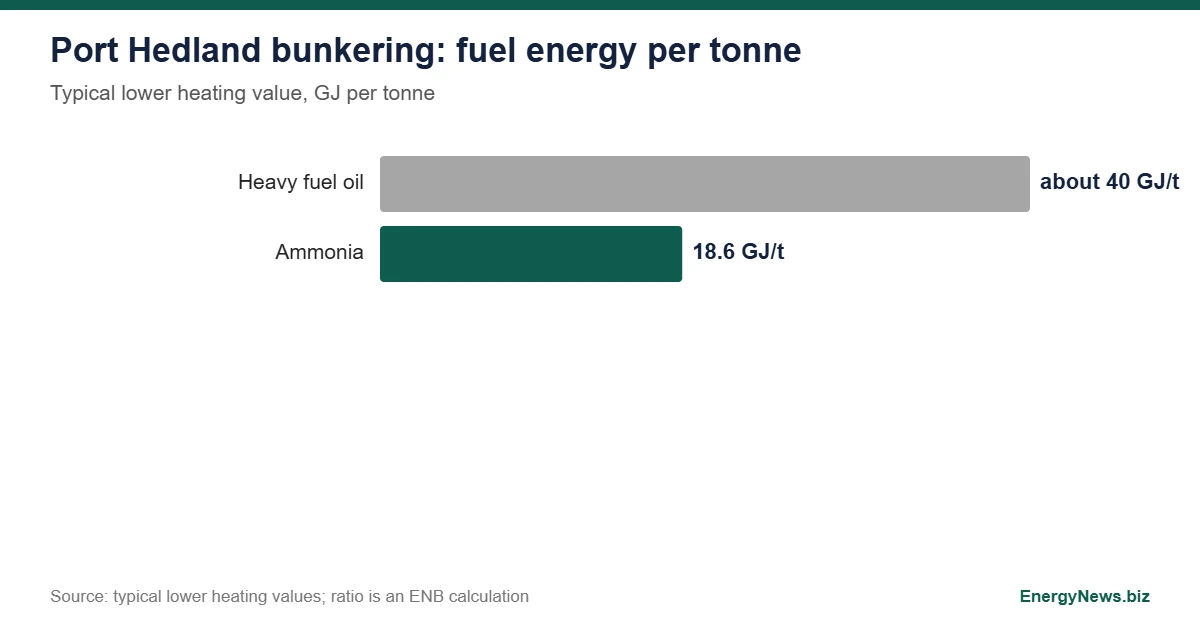
An ENB calculation shows the scale of the switch. Heavy fuel oil carries about 40 GJ of energy per tonne, ammonia about 18.6 GJ. A ship therefore needs roughly 2.1 tonnes of ammonia to replace the energy in one tonne of heavy fuel oil, before any difference in engine efficiency. Port storage, bunkering vessels and onboard tanks have to be sized for that extra mass and for ammonia’s toxicity.
Production on that scale is a long way off. AREH’s full 26 GW is a proposal, not a financed project, and the agreement does not set volumes, prices or dates. An ENB calculation: the 5 GW offered to data centres alone equals about 19% of AREH’s planned capacity, power that would not be available for ammonia.
Port Hedland in the race for ammonia-fuelled shipping
Shipping lines are preparing for ammonia elsewhere too, with retrofits such as the Maersk ammonia carrier project backed by the EU Innovation Fund, while efficiency gains remain the cheaper first step, as the data gap in shipping energy efficiency shows. Port information is published by Pilbara Ports.
For Port Hedland, the agreement is a study framework. The next measurable step is a first offtake volume of green ammonia from AREH, and a date for it, which neither party has yet published.
Add EnergyNews.biz as a preferred source on Google


