




Pumped hydro supplied more than 94 percent of the world’s grid storage capacity in 2025, at 201 GW against 189 GW the year before, according to International Hydropower Association figures cited in a new review in the Journal of Energy Storage. The review, by Massimo Guarnieri, compares seven mature grid storage technologies on eight technical and five economic indicators, and its historical sections show how much of today’s grid storage debate has older roots.
Grid storage in seven technologies at industrial scale
The review limits its comparison to technologies at technology readiness level 7 or higher, so that the comparison rests on operating plants and not on laboratory work: pumped hydro, compressed air, liquid air, flywheels, lithium-ion batteries, sodium-sulfur batteries and vanadium flow batteries. It separates bidirectional systems, which both store and deliver electricity, from unidirectional ones such as reservoir hydro, which can only delay delivery. Only the first group can fully complement variable wind and solar output, the review argues. First-of-a-kind plants are left out of the economic comparison because commercial data do not yet exist.
Pumped hydro: the grid storage benchmark
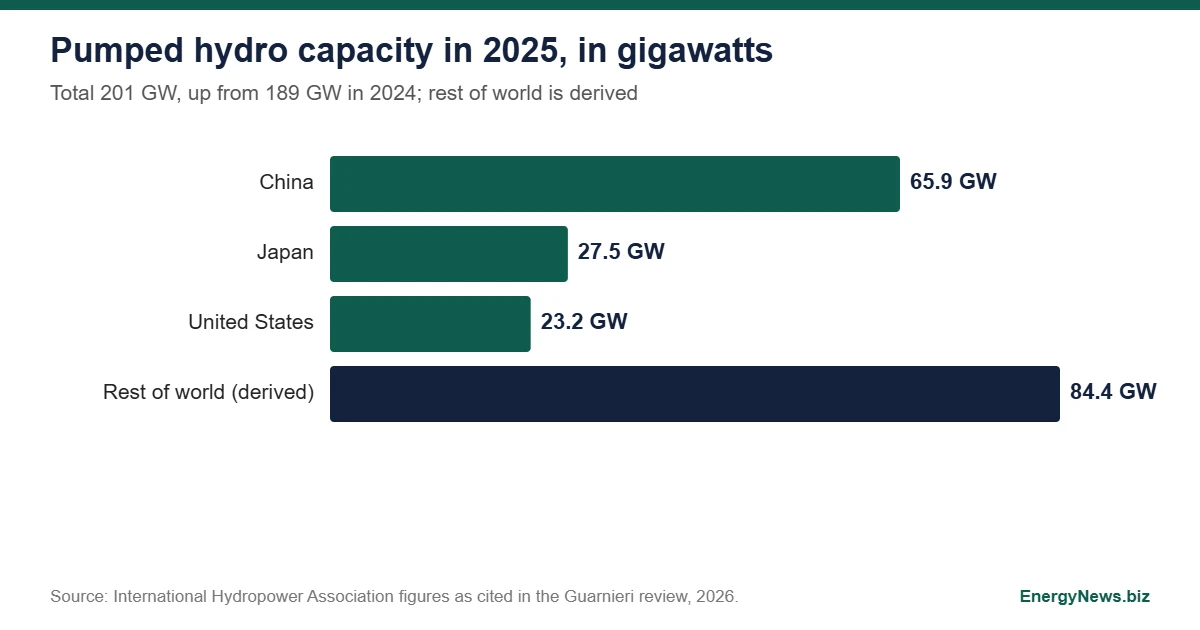
China holds 65.9 GW of pumped hydro, up 12.3 percent in 2025, ahead of Japan with 27.5 GW and the United States with 23.2 GW. Those three countries account for 116.6 GW, which leaves 84.4 GW (ENB calculation from the totals) elsewhere. The 12 GW added in 2025 is already above the average of about 10 GW a year that the International Renewable Energy Agency path to net zero implies, a need the review puts at more than 420 GW by 2050.
The technology’s figures are a baseline for every other grid storage option: round trip efficiency of 65 to 87 percent, a life of 30 to 50 years and self-discharge of 0.005 to 0.02 percent a day, which allows seasonal storage. Costs in the literature range from $6 to $250 per kWh of storage and from $430 to $5,950 per kW, and construction takes about 10 years. The review counts more than 80 plants above 1 GW in operation and more than 90 under construction, and it notes that opposition can end a project: the 5,000 MW, 120 GWh Pioneer-Burdekin scheme in Australia was cancelled in October 2024.
Compressed air and liquid air: the efficiency gap in grid storage
The old diabatic compressed air plants set a low bar. Huntorf in Germany, at 290 MW and 642 MWh, has a round trip efficiency of 42 percent, and McIntosh in Alabama, at 110 MW and 2,640 MWh, reaches 54 percent. Four adiabatic plants in China, commissioned in 2022 and 2024, report 60 to 70.4 percent, the best being Zhangjiakou at 100 MW and 400 MWh. The review gives Feicheng as 350 MW and 1,400 MWh in the text and as 300 MW and 1,800 MWh in a figure caption, a discrepancy worth checking against the plant data.
Liquid air is earlier in its life. Highview Power’s 2013 pilot reached no more than 15 percent, and its 50 MW, 300 MWh plant at Carrington, financed with £300 million and expected in 2026, has a projected efficiency of up to 54 percent and a capital cost of about $1,260 per kWh. Both figures are projections and not results.
Claims awaiting data
For compressed CO2, the review states that the 70 to 75 percent efficiency claimed has not been independently validated and that the effective figure for the 20 MW, 200 MWh plant at Ottana in Sardinia is not available. The European Investment Bank puts the plant’s total investment at about €70 million, or €3,500 per kW and €350 per kWh (20 MW and 200 MWh give the same arithmetic). The same technology is covered in Energy Dome’s Italian expansion. For gravity storage, the Rudong tower of 25 MW and 100 MWh is rated at 80 percent efficiency by its developer.
The sections read for this analysis were the abstract, introduction and the historical and technology sections, and the comparison tables of section 5 were not reviewed, so the ranking of the seven technologies is not reported here. The next dated checks are the Carrington plant in 2026 and the Irish compressed CO2 plant in 2028. For how batteries earn in grid storage markets, see the CAISO and ERCOT price study. Source: Guarnieri, Past and present of grid energy storage, Journal of Energy Storage 183 (2026) 125078.
Add EnergyNews.biz as a preferred source on Google


