




The Petrobras investment plan for 2027 to 2031 totals $122 billion, about 12% more than the $109 billion in the previous five-year plan. Brazil’s state-controlled oil company approved the plan in a release of 23 November, summarised by Enerdata.
About $113 billion goes to projects under implementation and $9 billion to less mature projects still under evaluation.
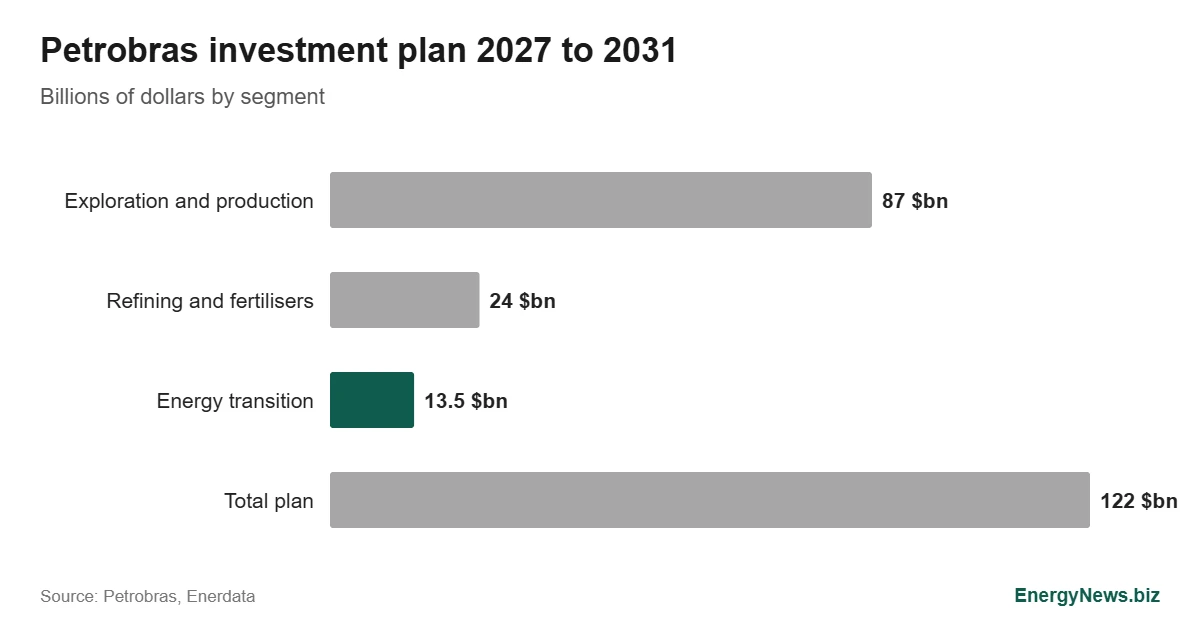
Where the Petrobras investment plan goes
Exploration and production take about $87 billion, more than 70% of the total. Within the projects under implementation, 60% is for pre-salt fields, 23% for post-salt and 12% for exploration. Exploration spending of about $10 billion includes around 50 wells in the Equatorial Margin, the southern and southeastern offshore basins and selected international areas. Complementary projects in existing fields, mainly in the Campos and Santos basins, get $14 billion.
Refining, transport, marketing, petrochemicals and fertilisers receive $24 billion. Installed refining capacity is to rise by 360,000 barrels a day to about 2.17 million barrels a day by 2031, and capacity for low-sulphur S-10 diesel by 405,000 barrels a day. The Boaventura complex and Train 2 at the Abreu e Lima refinery lead that expansion, with Train 2 due by 2029.
In the Petrobras investment plan, the energy transition receives about $13.5 billion: $6.7 billion for low-carbon diversification, $4.8 billion for cutting operational emissions and $2 billion for research, development and innovation. That is about 11% of the total.
The figures do not add up
As published, exploration and production, refining and energy transition alone add up to about $124.5 billion, more than the $122 billion total. Some categories probably overlap, for example emissions reduction spending inside upstream projects. The summary does not explain the difference, so the shares above are approximate.
Production targets
Petrobras plans to keep oil and natural gas liquids output at about 2.9 million barrels a day through the plan period. Commercial oil and gas output is set at 3.1 million barrels of oil equivalent a day in 2027 and about 3.2 million from 2028 to 2031. Nine new production systems and around 50 complementary projects support those targets.
How the plan compares
The previous Petrobras investment plan, for 2026 to 2030, was $109 billion. The increase of $13 billion is close to the size of the whole energy transition budget in the new plan, which shows where the growth went: mostly upstream. The share of exploration and production, above 70%, is typical for national oil companies with large low-cost reserves. Brazil’s pre-salt fields have some of the lowest production costs and emissions per barrel among offshore developments, which Petrobras uses as an argument that its barrels will remain competitive as global demand flattens.
The refining expansion is aimed at reducing Brazil’s diesel imports. More S-10 diesel capacity at home cuts exposure to import prices and freight.
Why it matters
For oilfield service companies, the Petrobras investment plan confirms Brazil as one of the busiest offshore markets of the decade, with steady demand for floating production units, subsea equipment and drilling rigs. For low-carbon suppliers, $6.7 billion for diversification is a meaningful budget, though small next to upstream. The Equatorial Margin wells will be closely watched; the region is environmentally sensitive and its licensing has been contested.
The plan also shows how national oil companies with low-cost reserves keep raising upstream budgets while international majors trim theirs. Other national companies are making similar choices in gas, as the LNG power plans in East Africa show.
What to watch
Watch the share of the plan that reaches the energy transition in practice. If actual low-carbon spending in 2027 runs below one fifth of the $13.5 billion five-year budget, the transition line in the Petrobras investment plan will look more like an option than a commitment.
Add EnergyNews.biz as a preferred source on Google


